
I must begin this article with a statement defining my work as an artist: My works are not provocative; they are provoked.
My art arises from the tensions, contradictions and events that already exist in society, in politics and in the human condition. That is why it is a mistake to believe that my work seeks to cause a scandal or provoke confrontation; it merely reflects, documents and responds to what reality reveals to me.
The reaction of the public, of institutions or of the systems that interact with my productions does not invalidate my intention, but rather confirms it as evidence of the range of conflicts I seek to show to others. Consequently, the provocation perceived by the viewer does not lie with me as an artist: it lies in society, in the facts, in the phenomena that the work brings to consciousness through the aesthetic experience.
In this regard, every personal, organisational or institutional response — insults, threats, censorship, administrative rulings, court judgments, and so on — forms an inseparable part of the works I create, demonstrating that art, in its broadest sense, not only observes and interprets the real and the apparent (being and non-being), but exposes itself to them, makes them manifest and records them in their individuality and totality.
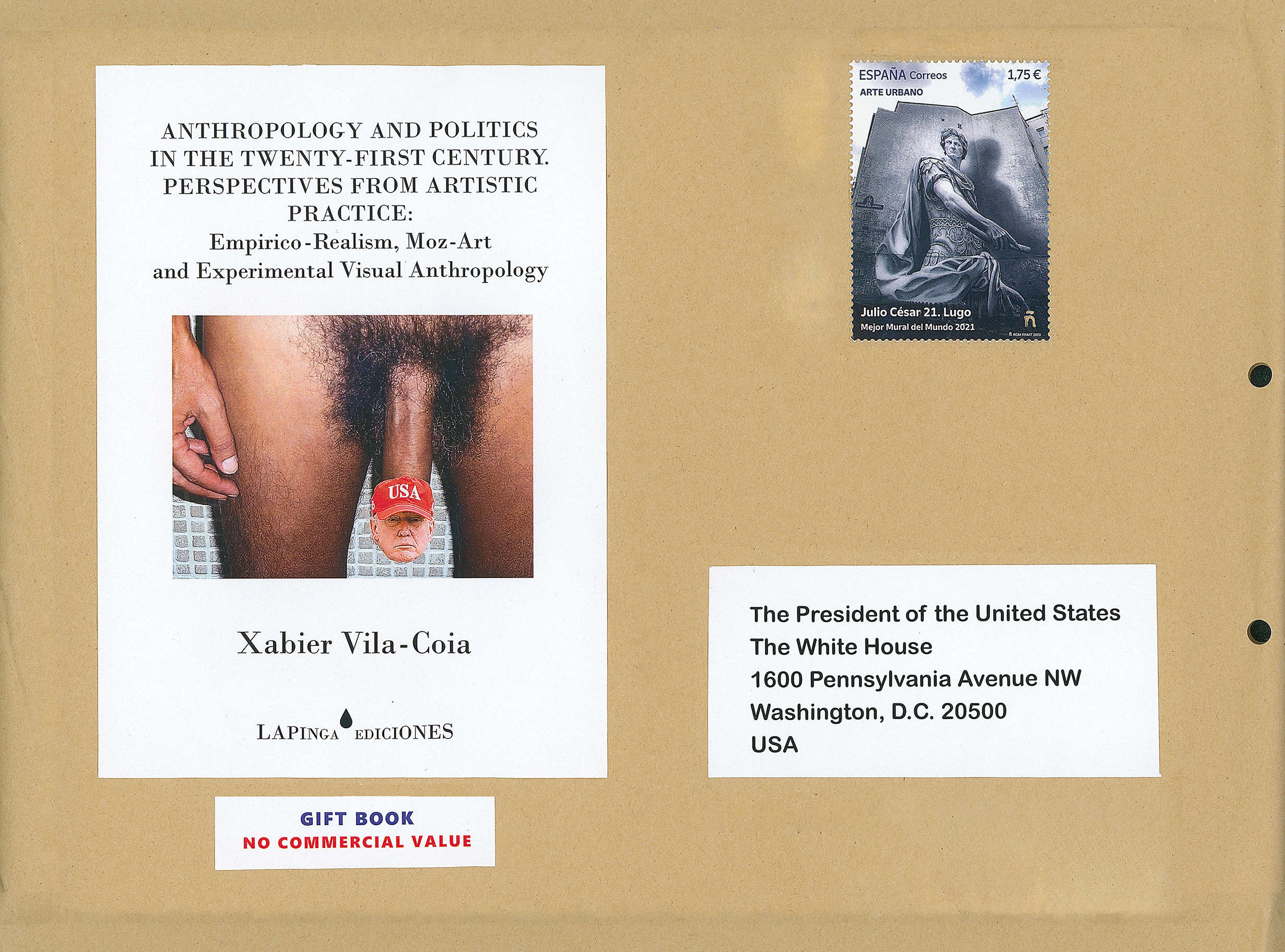
In November 2025, I published a new book entitled Anthropology and Politics in the Twenty-First Century. Perspectives from Artistic Practice: Empirico-Realism, Moz-Art, and Experimental Visual Anthropology, a translation of the Spanish version that had been published a few months earlier: La Antropología y la Política en el siglo XXI. Perspectivas desde la práctica artística: El Empirio-Realismo, el Moz-Art y la Antropologia Visual Experimental, whose cover image is a frontal photograph of a male nude framed between the pubis and the mid-thigh, in which I covered the glans of the penis with a portrait of the current President of the United States of America wearing his distinctive red cap bearing the inscription “USA” above the visor.
Given the multidisciplinary nature of the work, I sent it by registered post to the highest authority of each of the four main branches of the US Administration; namely: the Chief Justice of the Supreme Court (John G. Roberts), the Speaker of the House of Representatives (Mike Johnson), the Director of the FBI (Kash Patel), and President Donald Trump. I also sent it to the culture sections of The Washington Post and The New York Times, with an express request that they publish a review. On the outside of each envelope I affixed a print of the book’s cover on the left-hand side; and on the right, I included a postage stamp featuring the Julius Caesar mural, a “Street Art” piece created by the Lugo-based artist Diego As, which was considered the best mural in the world in 2021.
Only the last parcel reached its destination; the other five were returned by the State-owned enterprise Sociedad Estatal de Correos y Telégrafos to my post office box at the enterprise’s main office in Madrid’s Plaza de Cibeles as soon as they entered customs. According to the notice affixed to the envelopes, the return was made because they considered them to be “items that infringe upon individual rights”, clarifying that the ban includes any object or packaging with drawings, texts or messages that may “offend people’s sensibilities”.
However, they contained no illegal material, no criminal propaganda, nor any threatening documents. On the contrary, the front featured an artistic composition that forms part of a conceptual project which I myself have created and defined as “Political Mail Art”, a novel discipline that uses the postal system as a space for aesthetic circulation and political critique.
In truth, this piece of “Political Mail Art” is an allegory of the metamorphosis undergone by professional politicians during the process of running for office and their subsequent conduct once they have attained power. A metamorphosis made possible by the representative mandate established by liberal democracies, which, in contrast to the imperative mandate, legitimises elected politicians disregarding any promises made to citizens in order to secure their vote. I shall repeat this in a metaphorical sense using words which, given his disposition, could well be President Trump’s own, “The transformation consists, whilst being a ‘dickhead’, of believing oneself to be an 'empirehead’”. Hence, in the censored work, I juxtaposed the two historical figures who appear in it and entitled it DICKHEAD ≠ EMPIREHEAD; a title I am making public for the first time in this article for the information of readers.
The expression “offending sensibilities” invoked by Correos de España is extraordinarily broad: to what range of sensibilities does it refer? Whose sensibilities? By what objective criteria is this assessed? When the restriction of the circulation of an artistic work is based on the potential subjective sensitivity of third parties, the scope for preventing the visibility of art becomes virtually unlimited.
In response to my complaint regarding this action, the Sub-Directorate General for Postal Services confirmed the validity of the return, arguing that, in accordance with the Universal Postal Convention, the content was “obscene or immoral” and that, furthermore, it infringed fundamental rights under the Postal Services Regulations. However, it does not identify any specific right that has been infringed, describe where the alleged immorality of the images lies, or explain why the work crosses the legal threshold of obscenity. In other words, the Sub-Directorate General for Postal Services’ decision merely validates the postal operator’s criteria without providing any evidence to substantiate its conclusions.
This episode is not an isolated incident. Among the various instances of censorship and disregard directed at me — and at my uninterrupted, physical, intellectual, financial and educational work and effort since childhood — suffered throughout my career as an artist and essayist, two are particularly noteworthy: In 2011, an exhibition featuring a selection of aphorisms from my book entitled 213 Aphorisms for the Twenty-First Century, illustrated with images also created by me, was removed from the official programme of the First Week of Arts at the Complutense University, despite being listed in the institutional catalogue, without any justification whatsoever. And in 2022, my YouTube channel — featuring nearly 300 videos of essayistic and creative content and receiving over half a million views — was completely shut down, radically affecting the dissemination of my work as a creator and researcher.
Both these cases and the present one reveal a common pattern: works of reflective experimental art and unconventional thought are not subject to analysis and critical debate, but rather to preventive exclusion based on crude, prejudiced and unmotivated categories. Artists or thinkers who make people uncomfortable are not censored and ostracised because of illegality, social irresponsibility or a lack of depth, but because of the arbitrariness of an administrative, ideological, financial or algorithmic filter that protects and defends spurious interests; as well as because of the irrational fear of those agents who have the power to decide on the dissemination of their work.
I am not calling here for immunity for art or for the artist, for I am well aware, as a realist, that when one lives in society, freedoms are not absolute, though I will not overlook the fact that laws need not be so either. For this reason, in a democratic State governed by the rule of law, limits on freedom of expression and artistic creation must be exceptional, justified and proportionate. “Offending sensibilities” or alleging obscenity without clear and evident proof can never be sufficient grounds to prevent the free circulation of a work, the expression of a thought or the realisation of a way of interpreting the world.
The postal service is a matter of general interest. When it decides to return an artistic piece due to its visual content, it is not merely acting as a logistics operator but making a decision with implications for cultural freedom. If the primary criterion that preoccupies all public authorities, the vast majority of the media and a significant proportion of citizens is to avoid any possibility of subjective offence and positive creative freedom, what is achieved is the fostering of a tamed culture, devoid of friction or critical thought, which is the driving force that enables societies to improve and progress.
Therefore, the return of these parcels is not a minor courier incident. It is a symptom of something deeper: the normalisation of preventive filters that limit the space in which artistic expressions and ideas can circulate. As a creator of images and thoughts, I argue that a work should be able to travel and be exhibited not because of the author’s ego, but through the free will of its creative principles. For when art and thought cease to circulate, to be exhibited to the public, and even to be produced for fear of “offending sensibilities”, what is eroded is not the symbolism of a postal parcel’s cover: it is the very cultural freedom of an individual, of a people, of a nation… of all of Humanity!