
At the Paris Salon of 1850, the great realist painter Gustave Courbet presented his masterpiece: "Burial at Ornans". Beyond the scandal it caused by treating, in format and style, as a history painting what was nothing more than a common event, a burial in a rural village, the piece shows in all its crudeness the farewell of the village’s inhabitants to one of their neighbours, possibly the artist's maternal grandfather. You only have to stop and look carefully at the faces of the characters portrayed to realize the seriousness of the event.
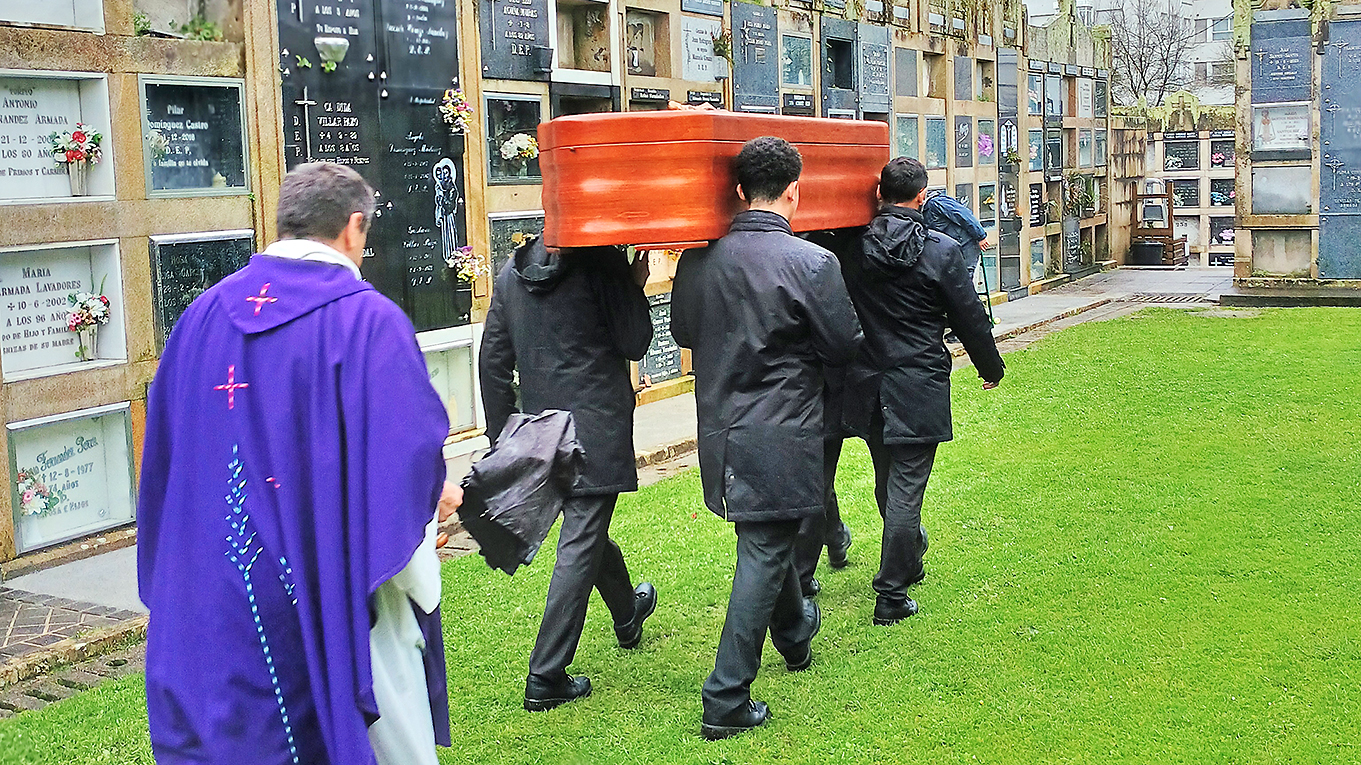
One hundred and seventy-six years later, nothing is the same. Today, the wakes that take place in funeral homes (the vast majority of them, since almost no one is allowed to die at home so as not to publicize the inevitability of death) are more like the exit from a cinema or a theatre – a situation in which spectators chat casually among themselves about the film or the performance they have seen -- than to a burial; to the point that it is not unusual for the staff of these centres to have no choice but to require that those present keep silent and show a minimum of respect towards the deceased.
And the fact is that the politically driven infantilisation typical of this era must be considered alongside the increasing infantilization of the fact of dying. Now we do not acknowledge that someone died, we say: he’s gone, he has left us, he is no longer with us...; expressions whose purpose is not to call things by their name – which means not knowing exactly what we are referring to or the importance of what has happened – to allow us to believe that at some point we may meet the deceased on the street or on holiday. That is, we deceive ourselves by transforming what is an end into an absence.
The infantilization of the fact of dying is complemented by the indefinite prolongation of life that scientists (those prestigious individuals of, with extraordinary exceptions, limited rational capacity but enormous capacity for work) promise to fearful and credulous commoners through the mass media.
These dwarfs of knowledge, although giants of method, are obsessed not so much with maintaining the youth of the body in its twenties (I suppose they consider it unfeasible, or not convenient because of the concupiscence of the young) as with achieving the slowing down of the decrepitude of old age for hundreds or thousands of years, which becomes incomprehensible since everyone complains about getting old. However, they are endeavouring to prolong, in a short period of time, the existence of man to one hundred and fifty or two hundred years. For the time being.
Is it that no one realizes the physical and mental limitations of a person after more than a hundred autumns?
Why don't we ask ourselves how an extended life would affect the mind as well as the body? How would it condition the perception we have of ourselves and others, and how would this supersurvival influence our belonging to the social group of which we are part? Why is it kept hidden that the “privilege” of extreme longevity would be an option only for a select few chosen by the genetic lottery and by their economic status?
It is true, however, that the body could endure - albeit badly or even worse, to borrow from a popular saying - whatever is thrown at it, as a popular saying goes; but not so the mind, which over the decades warns us unconsciously, preconsciously and consciously, that we are – and must be – finite; even the mind itself, since it deteriorates progressively and without respite. Nor is it able to bear the loneliness and pain caused by the disappearance of all the people we have known, appreciated and loved throughout our life journey, as well as the scenarios that shaped our memory, nor the inescapable boredom: that endless eternal return of what is always the same.
Suffering and dying are the two essences that identify us as the animal species that we are, no matter how "Homo sapiens" we feel. Two essences immanent to the human being, even if one day we manage to turn it into something else, into an entity with more being than human, which is what extreme old ultimately leads to.
Jonathan Swift left us lucid reflections on this question in Gulliver's Travels, a book published in October 1726, a few weeks before his fifty-ninth birthday. Below I transcribe what I consider most significant concerning the "struldbruggs" (the immortals of the kingdom of Luggnagg):
“At ninety, they lose their teeth and hair; they have at that age no distinction of taste, but eat and drink whatever they can get, without relish or appetite. The diseases they were subject to still continue, without increasing or diminishing. In talking, they forget the common appellation of things, and the names of persons, even of those who are their nearest friends and relations. For the same reason, they can never amuse themselves with reading, because their memory will not serve to carry them from the beginning of a sentence to the end; and by this defect, they are deprived of the only entertainment whereof they might otherwise be capable”.
“They were the most mortifying sight I ever beheld; and the women more horrible than the men. Besides the usual deformities in extreme old age, they acquired an additional ghastliness, in proportion to their number of years, which is not to be described”.
Recognizing that it is not easy, and achieving it can occupy us for a lifetime, we must undertake our death with the same naturalness with which we undertake our birth (both events which we did not ask for, which we cannot prevent, but which are the most significant of our existence): with resignation and dignity. I already advised as much in one of the aphorisms of my book "80 WhatsApp Statuses" (2024):
"It is preferable to die suffering than to suffer dying."